WhatsApp forms vs email forms: which works better?

Founder
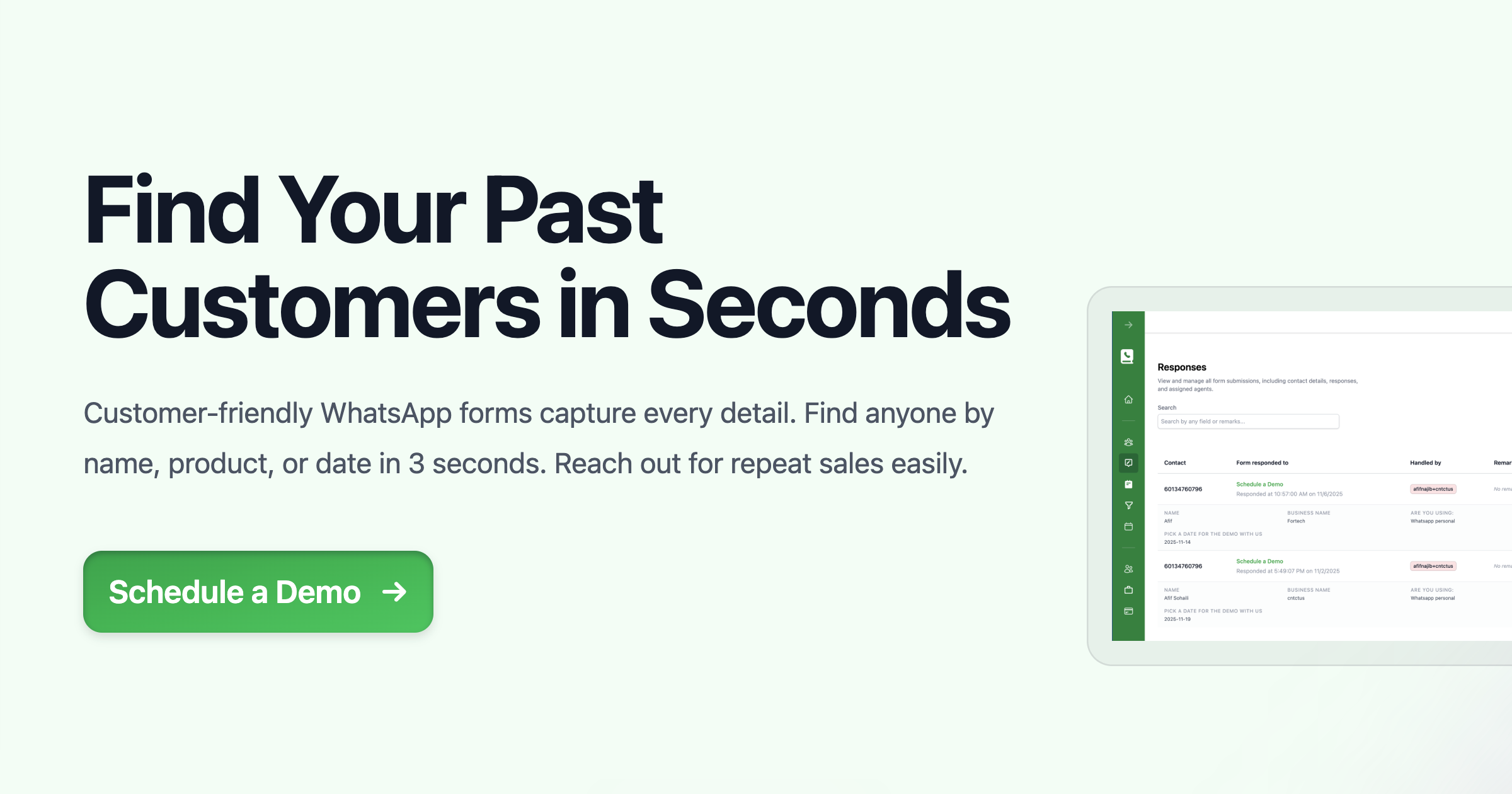
A WhatsApp form wins for a customer who already messages you: the form opens inside the app they are in, they answer in one tap, and the details land on their customer record instead of an inbox. An email form wins when the buyer is a company, needs a paper trail, or does not use WhatsApp at all.
That is the whole decision. Everything else people write about "open rates" and "response times" is a comparison of two channels measured on different audiences, so the numbers never apply to your shop.
What each one actually is
A WhatsApp form is a link you send in a chat. The customer opens it, fills a short form, and the answer comes back to you as structured data: item, quantity, delivery detail, date. You can build one with a form tool or run the same job inside the WhatsApp Business app with quick replies, but only the form writes a record.
An email form is a form page, a shared document, or a PDF that the customer fills and returns by email. It needs an email address, and the answer arrives as a message or an attachment.
The difference that matters is not the channel. It is what exists after the customer answers.
Where a WhatsApp form wins
- No new app. The customer is already in WhatsApp. The link opens, they answer, they go back to the chat.
- No address to collect. You need the phone number you are already messaging, not an email that can bounce or be mistyped.
- Answers come back in minutes. A chat notification is harder to miss than an email in a crowded inbox. That is a property of the channel, not a statistic.
- One record per customer. A form response can be stored against the customer, so the next order starts with their history instead of a scroll.
- It fits how small sellers already sell. Order, delivery detail, booking time, feedback after delivery: all short answers that suit a phone screen.
The catch is that this only works when the customer is on WhatsApp. For a Malaysian small business, that is most retail customers. For B2B buyers, it often is not.
Where an email form wins
- Formal paperwork. Purchase orders, signed quotes, tax details and legal notices need a thread that can be forwarded, printed and filed.
- Buyers who do not chat. Corporate procurement, overseas customers and older customers may never open WhatsApp.
- Long answers and attachments. A specification, a tender response or a scanned document is easier to handle in email than in a chat thread.
- A searchable trail. Email keeps a timestamped copy in a system your accountant or lawyer can read.
None of those are weaknesses of WhatsApp forms. They are jobs the channel was not built for.
The question that decides it
Ask where the answer has to live after it arrives.
If it has to sit next to the customer's past orders and be searchable by name or phone number, a form that writes a record is the right tool. If it has to be forwarded to someone else, signed, or kept as evidence, email is the right tool.
Most small sellers need both, for different customers. The mistake is using the chat as the record: a conversation with an order in it looks like a record until you need to find that order three months later.
What a WhatsApp form cannot do
A form does not replace an invoice, a receipt or a contract. It collects the details those documents need. Keep sending the document the way the customer expects it, and keep the form answer as the source.
A form also does not reach a customer who has not saved your number or does not use WhatsApp. There is no form link that fixes a channel the customer does not open. Collect an email address for those customers and send them the same questions there.
Running both without doing the work twice
- Use WhatsApp for the first ask. Order, booking, feedback after delivery: the moment the customer is in the chat, send the form link.
- Use email for the document. Quote, invoice, formal complaint: the form can collect the input, but the output goes by email.
- Keep one customer record. The record should hold the phone number, the email if you have it, and every order from both channels. Otherwise the same customer becomes two rows and neither is complete.
- Do not copy the same questions into two systems. One form, one place the answers land, whichever channel you sent it through.
A customer database you can search is what makes the split work. Without it, the WhatsApp answers live in chat and the email answers live in an inbox, and neither one tells you who buys again.
Frequently asked questions
Is a WhatsApp form better than an email form?
For a customer who already messages you on WhatsApp, yes. The form opens in the app they are already in, the reply takes one tap, and the answer can land on their customer record instead of an inbox. For a customer who does not use WhatsApp, the email form is the only one that reaches them.
When should I use an email form instead of WhatsApp?
When the buyer is a company, when the answer needs a paper trail, or when the customer does not use WhatsApp. Purchase orders, signed quotes and formal complaints belong in email, where the thread can be forwarded and filed.
Do customers need an email address for a WhatsApp form?
No. A WhatsApp form needs their phone number, which is the same number you are already chatting with. That is the practical difference for small sellers: no address to collect, and no bounce when it is typed wrong.
Can I collect orders on WhatsApp and keep a record of them?
Yes, if the form writes to a record instead of arriving as chat text. A form link collects the item, quantity, delivery detail and date into one answer, and the answer sits on the customer's record where you can search it later.
Do WhatsApp forms replace email marketing?
No. They replace the form, not the mailing list. Use WhatsApp for a customer who is already in a conversation with you, and keep email for newsletters, invoices and anyone who has not opted in to chat.
The short version
Send the WhatsApp form to the customer who is already in your chat, and keep email for the documents that need to be forwarded or filed. The order form is the same link for both jobs: one answer, one record, and a history you can search when the next order arrives.